
1976 Pontiac Grand Le Mans: The Red American Classic That Defines the 1970s
Few American cars capture the spirit of the 1970s quite like the 1976 Pontiac Grand Le Mans. With its long hood, imposing front end, rectangular headlights, chrome details and unmistakable red-and-white color combination, this classic Pontiac represents an era when American cars were all about presence, comfort and personality.
The featured 1976 Grand Le Mans is a beautifully restored example that brings together the generous proportions of a classic American coupe with the luxury-oriented character that distinguished the Grand Le Mans from the regular Pontiac Le Mans.
Finished in a striking red exterior with a contrasting white vinyl roof and whitewall tires, the car has the kind of visual presence that makes it immediately recognizable at any classic-car gathering.

The 1976 Pontiac Grand Le Mans combines dramatic proportions with the unmistakable styling of a 1970s American luxury coupe.
A Luxury Version of the Pontiac Le Mans
The Grand Le Mans occupied a more upscale position within Pontiac's Le Mans family. Compared with the standard Le Mans, it emphasized additional luxury, a larger and more substantial appearance, and styling details designed to give the car a more prestigious presence.
For 1976, the Grand Le Mans belonged to the fourth generation of the Le Mans line. Pontiac gave the model a distinctive front end featuring rectangular headlights and a unique grille design.
The result was a wide and imposing face that became one of the defining visual characteristics of the 1976 model.
The 1976 Grand Le Mans Was Big, Bold and Unmistakably American
Size played an important role in the personality of American automobiles during the 1970s, and the Grand Le Mans was no exception.
Its long body, broad stance and substantial proportions give the coupe a presence that is difficult to reproduce with today's smaller and more aerodynamic vehicles.
Rather than attempting to hide its dimensions, the Pontiac embraced them. The long hood, wide grille and large chrome bumpers all contribute to an appearance that feels unmistakably American.
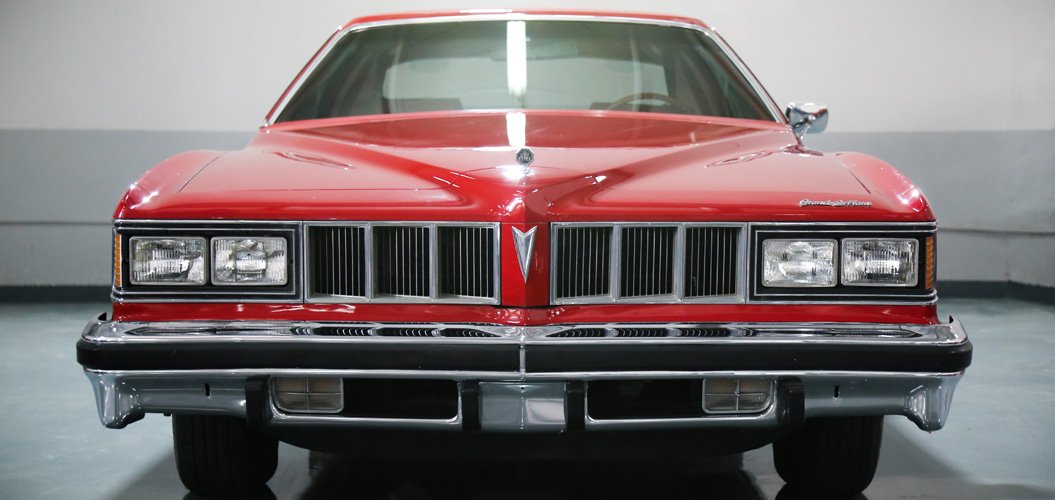
The distinctive rectangular headlights and split grille define the front end of the 1976 Grand Le Mans.
Red Paint and White Vinyl Roof
The featured car's exterior color combination is one of its strongest visual features.
The vibrant red paint highlights the car's extensive chrome trim, while the white vinyl roof provides a sharp contrast across the upper portion of the body.
The combination is completed by whitewall tires and wheels that complement the exterior color scheme, giving the Pontiac the classic appearance associated with premium American cars of the period.
It is a design that does not rely on subtlety. Every element contributes to the Grand Le Mans's larger-than-life personality.
V8 Power Beneath the Long Hood
The 1976 Pontiac Grand Le Mans was offered with both six-cylinder and V8 powertrains, giving buyers different levels of performance and capability.
The featured showroom example is described as a V8-powered model with a 350-cubic-inch engine, paired with an automatic transmission.
A 350-cubic-inch engine corresponds to approximately 5.7 liters, placing the car firmly within the traditional American V8 formula of its era.
| Specification | 1976 Pontiac Grand Le Mans |
|---|---|
| Model year | 1976 |
| Manufacturer | Pontiac |
| Model | Grand Le Mans |
| Body style | 2-door coupe |
| Engine | 350 cubic-inch V8 |
| Engine displacement | Approximately 5.7 liters |
| Transmission | Automatic |
| Drive | Rear-wheel drive |
| Exterior color | Red |
| Roof | White vinyl |
| Tires | Whitewall |
| Reported mileage | 73,025 miles |
The exact engine output varied according to the specific engine configuration available in 1976. For that reason, this report focuses on the 350-cubic-inch V8 configuration identified for the featured car rather than assigning a single horsepower figure without a verified engine specification.
The Front End Is Pure 1970s Pontiac
The front of the Grand Le Mans is perhaps its most recognizable feature.
Four rectangular headlights sit prominently within the broad front fascia, while the split grille creates a strong visual center around the Pontiac emblem.
Chrome bumpers extend across the width of the vehicle, reinforcing the substantial character of the car.
The design is unmistakably from the mid-1970s, a period when American manufacturers were experimenting with increasingly formal and luxurious front-end designs.
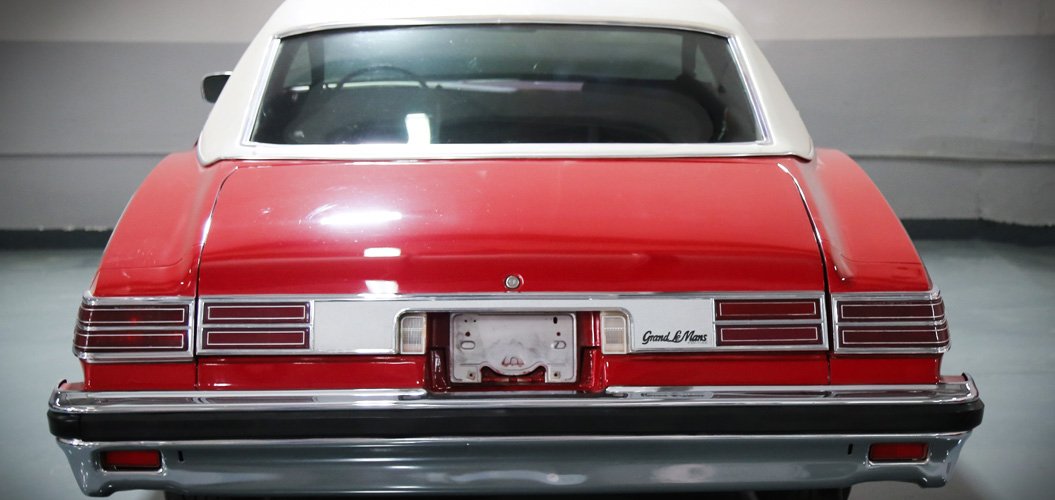
The rear design features broad horizontal lighting elements, chrome trim and the contrasting white roof.
A Rear Design Full of Chrome and Character
The rear of the Grand Le Mans continues the same philosophy as the front: large, wide and highly detailed.
Horizontal taillight elements stretch across the rear corners, while chrome trim runs across the body and bumper.
The white vinyl roof provides another strong contrast with the red body, making the car particularly attractive from the rear three-quarter angle.
This is exactly the kind of styling that defined American luxury cars before aerodynamic efficiency became one of the industry's dominant design priorities.
The Interior Continues the Red Theme
Inside, the featured Pontiac continues its red color theme with a cabin that emphasizes comfort rather than minimalism.
The red seats, dashboard and door panels create an atmosphere that feels instantly connected to the decade in which the car was built.
The large steering wheel, traditional analog gauges and broad dashboard are reminders of a time when driving environments were dominated by physical controls and large, clearly visible instruments.
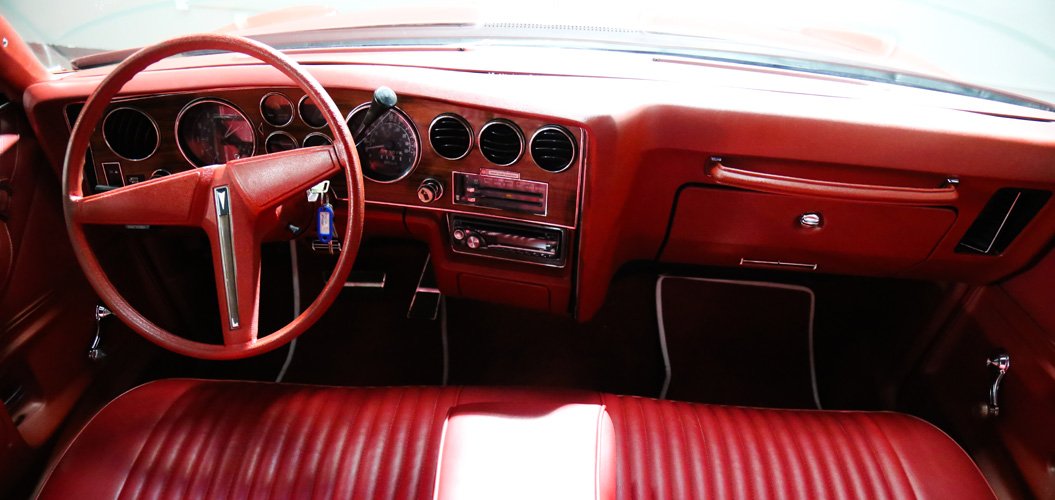
The red interior reinforces the period character of this restored American classic.
Comfort Was Part of the Grand Le Mans Experience
The Grand Le Mans was not designed simply as a performance machine. It was created as a more luxurious interpretation of the Le Mans formula.
That meant comfortable seating, a spacious cabin and an emphasis on relaxed cruising.
The combination of a large body, automatic transmission and V8 power made the car particularly suited to the traditional American road-trip experience.
A Snapshot of the American 1970s
The 1976 Grand Le Mans is more than an old Pontiac. It represents a specific moment in American automotive history.
The mid-1970s were a fascinating period for the American automobile industry. Cars were still large and heavily styled, but manufacturers were also adapting to changing regulations, fuel concerns and evolving consumer expectations.
The Grand Le Mans sits directly within that transition period, retaining the visual drama and generous proportions associated with earlier American cars while incorporating the equipment and styling trends of the middle of the decade.
1976 Pontiac Grand Le Mans: Design Highlights
- Large American luxury coupe proportions.
- Four rectangular headlights.
- Distinctive split Pontiac grille.
- Extensive chrome exterior trim.
- Red exterior finish.
- Contrasting white vinyl roof.
- Whitewall tires.
- Classic red interior.
- Traditional analog instrument cluster.
- V8 power.
- Automatic transmission.
- Rear-wheel-drive layout.
How Large Was the 1976 Grand Le Mans?
The Grand Le Mans was a substantial American intermediate car. The 2-door coupe measured roughly 208 inches in length and about 77.4 inches in width, with a wheelbase of approximately 112 inches, depending on the specific configuration.
Those dimensions help explain the car's imposing road presence. Even by the standards of classic American automobiles, the Grand Le Mans projects a considerable amount of visual mass.
The Grand Le Mans Was Offered With Multiple Engines
One interesting aspect of the 1976 Grand Le Mans is that the model was not limited to a single engine.
Period specifications included six-cylinder and several V8 options. Depending on configuration, buyers could choose engines including 260, 350, 400 and 455 cubic-inch V8s.
The featured example's 350-cubic-inch V8 therefore places it within a broader family of powertrain choices available to Grand Le Mans buyers during the 1976 model year.
Why This Pontiac Still Attracts Attention
There is something increasingly special about a car that makes no attempt to look like anything else.
The 1976 Pontiac Grand Le Mans has a personality that is immediately visible. Its enormous proportions, chrome details, rectangular headlights and two-tone red-and-white appearance make it impossible to mistake for a modern automobile.
For classic-car enthusiasts, that individuality is part of the appeal.
The Grand Le Mans is also an excellent reminder of how dramatically automotive design has changed over the last five decades.
A Restored Piece of American Automotive History
The example presented by the classic-car showroom has been restored to emphasize its original character.
The combination of glossy red paint, white vinyl roof, matching interior and whitewall tires gives the vehicle the appearance of a carefully preserved 1970s American luxury coupe.
Rather than modernizing the car beyond recognition, the restoration allows the Pontiac to retain the design language that made it special in the first place.
1976 Pontiac Grand Le Mans vs. Today's Cars
Driving a Grand Le Mans today would be a very different experience from driving a modern sedan or coupe.
Modern cars prioritize aerodynamic efficiency, compact dimensions, advanced electronics and fuel economy. The Pontiac represents almost the opposite approach.
It emphasizes physical presence, mechanical character, generous cabin space and traditional American styling.
That difference is precisely why cars such as the Grand Le Mans remain fascinating to collectors.
- Iconic 1970s Pontiac styling.
- Large two-door American coupe body.
- 350-cubic-inch V8.
- Automatic transmission.
- Red exterior with white vinyl roof.
- Whitewall tires.
- Restored condition.
- Period-correct red interior.
- Reported 73,025-mile odometer reading in the supplied showroom description.
Frequently Asked Questions
What is the 1976 Pontiac Grand Le Mans?
The 1976 Pontiac Grand Le Mans was the more luxurious version of Pontiac's intermediate Le Mans, offered as part of the fourth-generation Le Mans family.
What engine does the featured 1976 Grand Le Mans have?
The featured car is described as having a 350-cubic-inch V8 engine, equivalent to approximately 5.7 liters.
Does the 1976 Pontiac Grand Le Mans have an automatic transmission?
Yes. The featured showroom example is equipped with an automatic transmission.
What makes the 1976 Grand Le Mans distinctive?
Its most recognizable features include four rectangular headlights, a split Pontiac grille, large chrome bumpers, a long body and classic 1970s American proportions.
What color is the featured Grand Le Mans?
The featured car has a red exterior with a contrasting white vinyl roof and whitewall tires.
How many miles does the featured car have?
The showroom description supplied for this report states approximately 73,025 miles. The current online listing associated with the vehicle displays a different mileage figure, so the odometer should be verified directly before publication as a current specification.
VibCar Verdict
The 1976 Pontiac Grand Le Mans is a spectacular reminder of the era when American automobiles were defined by size, chrome, V8 power and unmistakable personality.
With its red body, white vinyl roof, whitewall tires, four rectangular headlights and imposing proportions, this Pontiac looks exactly like what many enthusiasts imagine when they think of a classic American car from the 1970s.
The 350-cubic-inch V8 and automatic transmission add to its traditional American character, while the restored red interior completes the period-correct experience.
It may not have the technological sophistication of a modern vehicle, but that is exactly the point. The Grand Le Mans offers something today's cars rarely can: an unmistakable connection to a completely different era of automotive design.
For anyone who loves big American classics, the 1976 Pontiac Grand Le Mans is not simply a car — it is a rolling piece of 1970s automotive culture.
%20(1).png)


.png)
0 Comments